


Swiss Ball Ab Roll-Out 101 Video Tutorial
0
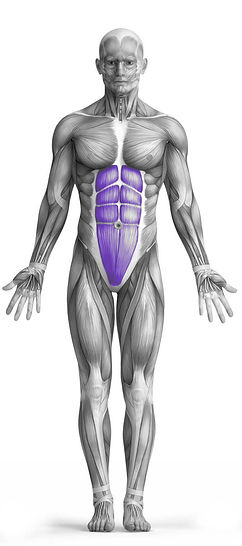

Exercise Synopsis
Target Muscle Group
Abs
Secondary Targets
Execution
Compound
Force Type
Core
Required Equipment
Exercise Ball
Fitness Level
Intermediate
Variations
None
Alternatives
None
Timer
Hour
Minute
Second
Stopwatch
00:00:00:00
Overview
The Swiss Ball Ab Roll-Out is a core-focused exercise that challenges the abdominal muscles through controlled extension and stabilization while using an exercise ball to increase instability. As the body rolls forward and backward, the abs work to prevent excessive spinal extension, while the lats, shoulders, serratus, and hip flexors assist in stabilizing the upper body and controlling the movement of the ball. This exercise emphasizes core strength, anti-extension control, and full-body coordination, making it an effective progression for improving trunk stability and overall core engagement.
How to Perform
Kneel on the floor and place the exercise ball directly in front of you, positioning both forearms and hands on top of the ball with elbows bent under the shoulders.
Engage your core by tightening your abs, lightly squeezing your glutes, and keeping your spine neutral from head to knees.
Slowly roll the ball forward by extending your arms and allowing your shoulders to move ahead, while maintaining full control through the abs.
Continue rolling forward until you reach a range where the abs are fully engaged without allowing the lower back to arch or collapse.
Keep your chest slightly tucked, ribs pulled down, and shoulders stable as the lats, serratus, and shoulders assist with control.
Pause briefly at the extended position while maintaining tension through the abs and hip flexors.
Initiate the return by pulling the ball back toward your knees using your abdominal muscles, not momentum.
Roll back to the starting position with controlled movement, maintaining a neutral spine and constant core engagement throughout the entire repetition.
★ Bonus: For exercises that involve external weights (such as dumbbells, barbells, or machines), the One Rep Max (1RM) calculator can help you estimate your maximum lifting capacity. Use it to track your strength progress and adjust your training for optimal results.
Tips
Maintain a neutral spine throughout the movement to keep constant tension on the abs.
Actively brace the core before each repetition to prevent lower-back arching.
Keep the ribs pulled down and avoid flaring the chest as the ball rolls forward.
Apply steady pressure through the forearms and hands to improve shoulder and serratus stability.
Move slowly and with control to maximize abdominal engagement and reduce momentum.
Squeeze the glutes lightly to support pelvic stability and reduce hip flexor dominance.
Limit the range of motion to the point where core control can be maintained without compensation.
Exhale gently during the rollout to reinforce abdominal bracing and control.
How Not to Perform
Do not allow the lower back to arch or sag during the rollout, as this shifts tension away from the abs and increases spinal stress.
Do not rush the movement or use momentum to roll the ball forward or backward.
Do not let the ribs flare upward or the chest collapse as the arms extend.
Do not relax the core at any point, especially at the fully extended position.
Do not push excessively through the shoulders and arms instead of initiating the movement with the abs.
Do not let the hips drift forward or the pelvis tilt excessively during the rollout.
Do not roll beyond your controllable range of motion where abdominal tension is lost.
Do not hold your breath, as this reduces core control and stability.
Variations
Variations of fitness exercises refer to different ways of performing a specific exercise or movement to target various muscle groups, intensities, or goals. These variations aim to challenge the body differently, prevent plateaus, and cater to individuals with varying fitness levels.
Alternatives
Alternative exercises in fitness refer to different movements or activities that target similar muscle groups or serve the same training purpose as the primary exercise. These alternative exercises can be used as substitutes when the original exercise is unavailable or challenging to perform due to various reasons such as equipment limitations, injuries, or personal preferences.
